


 Deutsch
 English
 Italiano
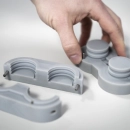
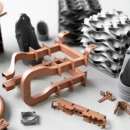
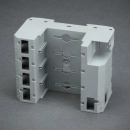
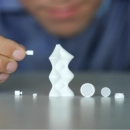







Stereolithography (SLA): 3D printing for smooth, highly detailed plastic parts
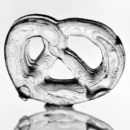
Stereolithography (SLA) is a 3D printing process in which light in the UV or near-UV range – usually a laser – cures liquid synthetic resin layer by layer. This produces parts with a smooth surface and fine details – including transparent ones. Because the part is built in liquid resin, it needs support structures, which are removed after printing.
Stereolithography was developed in the 1980s and is one of the oldest 3D printing processes. Typical applications include design and visual models, form and functional prototypes, transparent parts and master models for casting processes. PROTIQ manufactures SLA parts in its own production facility; other suppliers also offer the process on the PROTIQ Marketplace.
SLA at a glance
- Materials
- Synthetic resins (photopolymers)
- Support structures
- required
- Surface
- comparatively smooth
- Detail resolution
- fine
- Quantity
- Single part to small series
Applies to parts manufactured by PROTIQ itself, unless otherwise stated in the quote. Larger tolerances apply to some resins; other suppliers state their tolerances in their respective quotes.
How it works
How does stereolithography work?
In conventional systems, a UV laser traces the cross-section of the part on the surface of a resin bath and cures the liquid resin there. The build platform then lowers by one layer thickness, a new layer of resin covers it, and the process repeats until the part is finished.
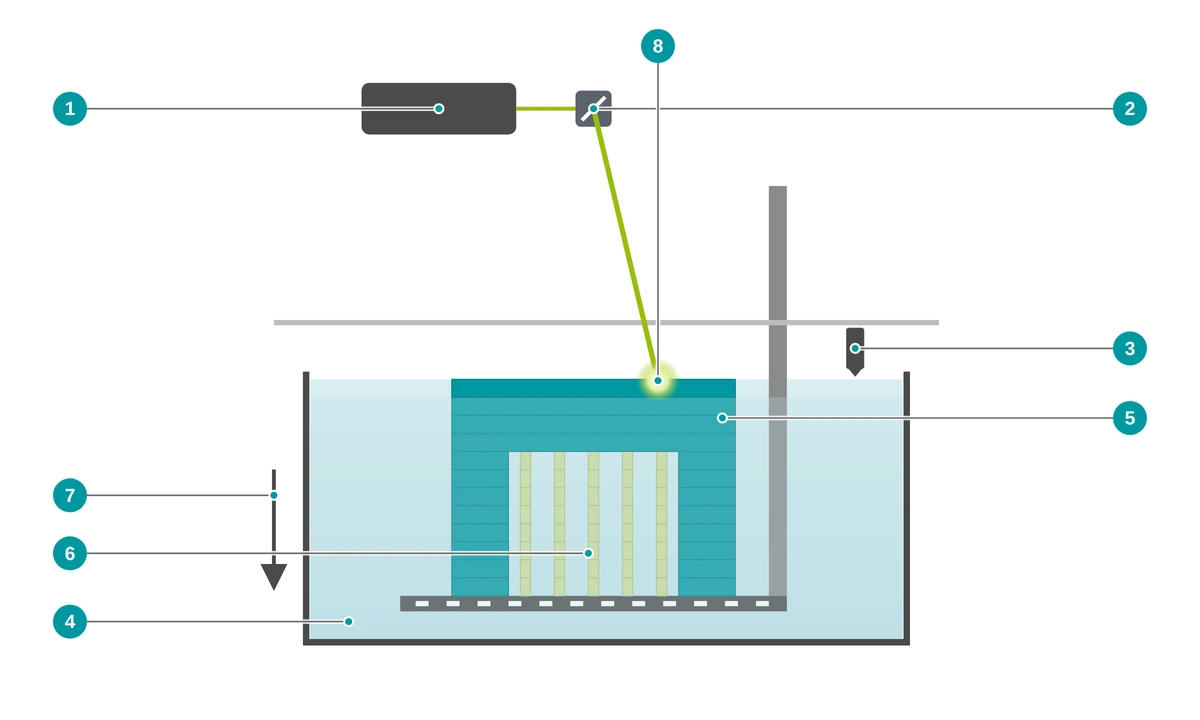
- 1 UV laser
- 2 Scanner mirrors deflect the laser beam
- 3 Recoater (wiper) ensures an even resin layer
- 4 Vat containing liquid synthetic resin
- 5 Part, built layer by layer
- 6 Support structures – removed after printing
- 7 Build platform lowers after each layer
- 8 Laser cures the current layer
- Prepare data The 3D model is oriented, provided with support structures and sliced into thin layers.
- Exposure The UV laser cures the resin along the cross-section. The support structures are made from the same material in the process.
- Lower and recoat The platform lowers by one layer thickness and a new layer of resin is spread evenly. This is repeated until the last layer.
- Cleaning The finished part is raised out of the resin bath and cleaned of adhering resin with a solvent such as isopropanol.
- Post-curing The part is post-cured under UV light and reaches its final properties. Some resins are additionally given a thermal post-treatment.
- Support removal and finishing The support structures are removed and the contact points reworked. Sanding, polishing or painting follow on request.
SLA on video
Watch the video to see how stereolithography works.
Uncured resin in the vat can be reused for further build jobs.
↑ Back to overviewSLA or SLS?
What is the difference between stereolithography and laser sintering?
Both processes usually work with a laser, but with different starting materials: stereolithography cures liquid resin, while laser sintering fuses plastic powder. SLA stands out for its smooth surface and fine details, SLS for robust parts without support structures.
| Stereolithography (SLA) | Laser sintering (SLS) | |
|---|---|---|
| Starting material | liquid synthetic resin (photopolymer) | plastic powder, e.g. polyamide |
| Support structures | required, removed after printing | not required |
| Surface | smooth | slightly rough and matte |
| Detail resolution | fine | medium |
| Mechanical properties | depends on the resin; rather stiff and less impact-resistant | tough and resilient |
| Transparency | possible with transparent resins | not common (opaque parts) |
| Typical use | Design and visual models, transparent parts, master models | Functional parts, small series, movable assemblies |
Which process is better suited to your part depends on appearance, load, geometry and quantity. Upload your file and compare the offers for both processes directly in the configurator.
↑ Back to overviewAdvantages
What are the advantages of stereolithography?
Stereolithography is a proven choice when appearance and detail accuracy are the priority: smooth surfaces, fine details and, on request, transparent parts.
Smooth surfaces
The surface is comparatively smooth straight after printing. For visible surfaces and master models, slight layer steps and support marks are usually sanded off.
Fine details
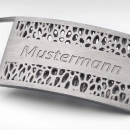
Small structures, lettering and sharp edges can be reproduced very finely – the minimum sizes depend on the resin and system.
Transparent parts
Transparent resins produce see-through parts – for example for visual models or flow studies.
Easy post-processing
SLA parts can be sanded, polished and painted – right up to clear polished surfaces.
Master models for casting processes
Thanks to their smooth surface, SLA parts are suitable as master models, for example for vacuum casting.
No tooling costs, from one part
No tooling, no mold costs – from single parts to small series.
Materials
Which materials are available for stereolithography?
Stereolithography processes liquid synthetic resins (photopolymers). Robust, transparent and heat-resistant resins are available on the PROTIQ Marketplace.
You can see which materials are currently available after uploading in the configurator – where you will also find the suppliers’ current data sheets.
Robust
According to the manufacturer, VisiJet Tough and Accura Xtreme are ABS-like, comparatively robust resins – for form and functional prototypes, detailed components and master models.
Transparent
RS Clear and Somos WaterShed XC 11122 produce see-through parts – for example for visual models, flow studies or master models. For the clearest possible appearance, the parts are usually post-processed.
Heat-resistant
After thermal treatment, RS High Temp achieves a high heat deflection temperature – for prototypes that are tested in warm environments.
Properties compared
| Material | Color | Tensile strength (MPa) | Tensile modulus (MPa) | Elongation at break (%) | Heat deflection temperature 0.45 / 1.82 MPa (°C) |
|---|---|---|---|---|---|
| VisiJet Tough | gray | 41 | 1,890 | 18 | 62 / 54 |
| Accura Xtreme | – | 41 | 1,890 | 17 | –¹ |
| RS Clear | transparent | 65 | 2,800 | 6.2 | 73 / 58 |
| Somos WaterShed XC 11122 | nearly colorless, clear | 50 | 2,770 | 15.5 | 50 / 49 |
| RS High Temp | amber | 58 | 2,750 | 3.3 | 238 / 101² |
Values from the data sheets of PROTIQ Marketplace suppliers, rounded. No guaranteed properties; the values depend on post-curing, part geometry and build orientation, among other factors. The data sheet of the respective supplier in the ordering process is binding.
¹ According to the supplier’s data sheet, dimensionally stable up to approx. 60 °C (glass transition temperature approx. 70 °C). ² After thermal treatment. The data sheets are partly based on different test standards and are only comparable to a limited extent. Heat deflection temperature is not a continuous service temperature.

Technical data
Technical data and design guidelines for SLA
Unless otherwise specified in the quote, SLA parts manufactured by PROTIQ itself are subject to a standard tolerance of ± 0.3%, but not tighter than ± 0.05 mm. Larger tolerances apply to some resins. Part size, minimum wall thickness and dimensional accuracy depend on the resin, supplier and system.
| Feature | Value |
|---|---|
| Maximum part size | depends on the supplier’s system – checked automatically on upload |
| Standard tolerance at PROTIQ | ± 0.3%, not tighter than ± 0.05 mm, unless otherwise stated in the quote |
| Dimensional accuracy per material | according to data sheets, e.g. ± 0.3% / ± 0.05 mm (VisiJet Tough), ± 0.3% / ± 0.1 mm (RS Clear) or ± 0.5% / ± 0.1 mm (RS High Temp) |
| Minimum wall thickness | depends on resin and supplier, e.g. 0.4–0.5 mm (Accura Xtreme, according to the supplier’s data sheet) |
| Surface | smooth; reworked at the support points |
| Support structures | required |
| Color | depends on resin, e.g. gray, transparent or amber; paintable |
Guide values, no guaranteed properties. The information provided by the respective supplier in the ordering process or in the quote is binding.
What to consider when designing
- Specify visible surfaces Small marks remain at the support points after removal. Specify visible surfaces when ordering or requesting a quote – they are taken into account when orienting the part, as far as the geometry allows.
- Cavities with drainage holes Liquid resin remains trapped in closed cavities. Provide openings so that it can drain out and the part can be cleaned.
- Thin, long structures Fine webs and thin walls are possible but may warp or break. Reinforce them where the function allows.
- Snap-fit connections Many resins are stiffer and less impact-resistant than polyamide. Laser sintering is often better suited for snap hooks and living hinges.
- Threads and fits It is better to recut small threads or use threaded inserts. Tight fits should be reworked.
- Transparent parts For the clearest possible appearance, sanding, polishing or a clear coat is required. Plan easily accessible surfaces for this.
Limits & alternatives
When is another process better than SLA?
- Impact resistance Many resins are stiffer and more brittle than polyamide. For highly stressed functional parts, laser sintering is often the better choice.
- UV resistance SLA parts are only partially UV-resistant. A UV-protective coating can slow down aging; whether a part can be used permanently outdoors must be checked on a case-by-case basis.
- Temperature The heat deflection temperature of many standard resins is around 50–60 °C. Special resins such as RS High Temp are available for higher temperatures.
- Support structures Supports must be removable. This somewhat limits design freedom, and small marks remain at the contact points.
| Process | Strengths | May be the better choice if … |
|---|---|---|
| Laser sintering (SLS) | Robust, tough parts without support structures | … your part is subject to mechanical loads or has snap-fit connections |
| Multi Jet Fusion (MJF) | Powder bed process without support structures, parts usually grayish | … you need robust functional parts with a short build time |
| PolyJet / MultiJet | Multicolor parts and combinations of hard and soft materials | … your model needs to be multicolored or have soft areas |
| Vacuum casting | Small series made of PU materials that replicate production plastics – often with an SLA master model | … you need several identical parts in small quantities |
| Injection molding | Cost-effective for large quantities | … the quantity is large enough for an injection mold to pay off |
VisiJet, Accura, Somos, WaterShed, Multi Jet Fusion, PolyJet and MultiJet are trademarks of their respective owners.
↑ Back to overviewApplications
What is stereolithography used for?
Stereolithography has proven itself in prototyping for decades. Today it is used to produce design and functional prototypes, visual models, transparent parts and master models for casting processes.

Prototyping
Design and functional prototypes with a smooth surface – to assess form, fit and appearance at an early stage.
To prototyping
Model making
Detailed visual and architectural models with fine structures.
To model makingMaster models
Master models for vacuum casting – the smooth surface is transferred to the castings.
To vacuum casting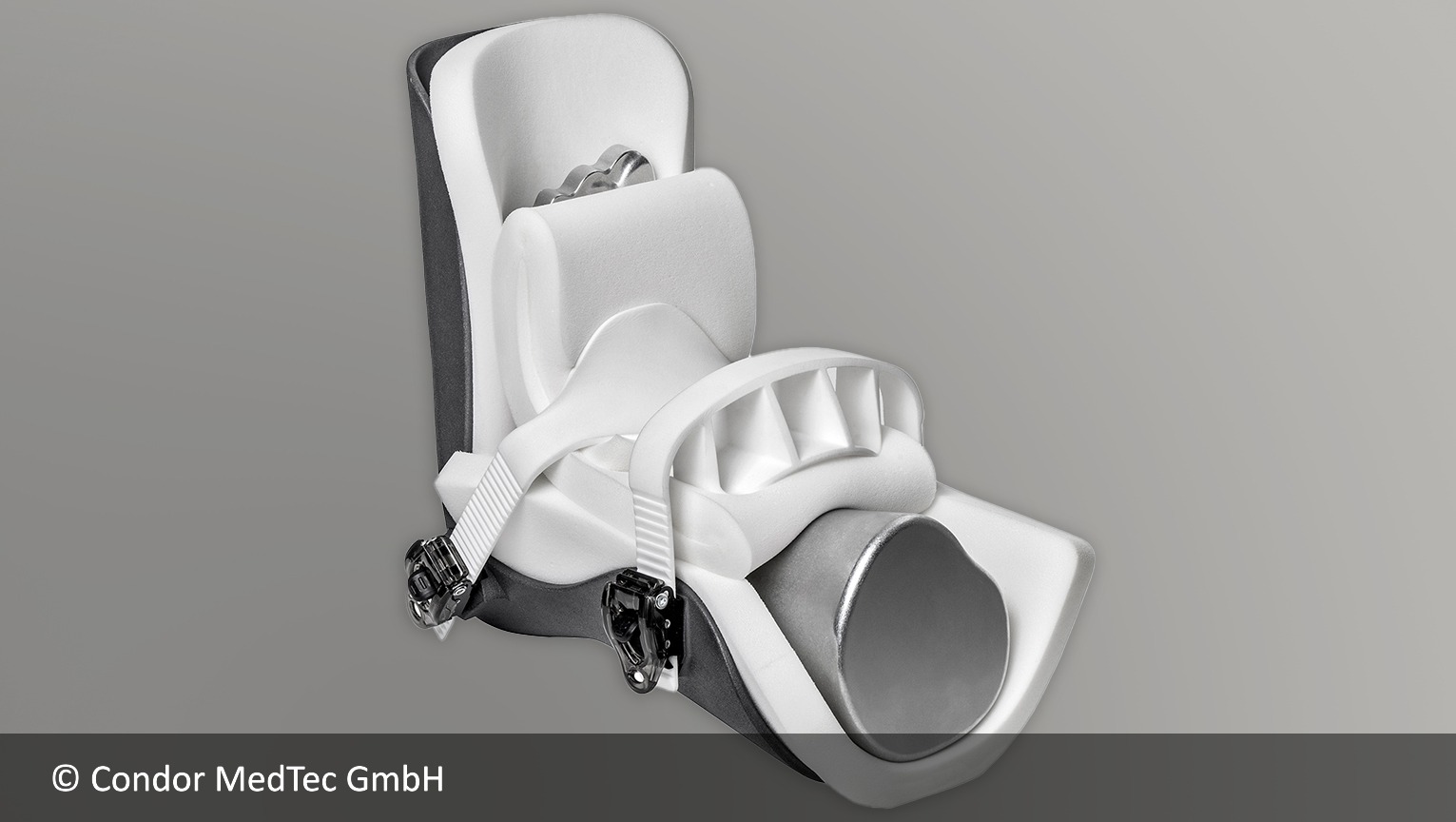
Medical technology
Visual models and prototypes. Whether a material is suitable for a medical application must be checked on a case-by-case basis – we will be happy to advise you.
To medical technologyOrder
How do I order SLA parts?
Upload your 3D file, choose the material and process and compare the suppliers’ offers. You decide who manufactures your part.
- Upload file Upload your 3D data in the configurator. The system automatically checks whether the part fits into the build space.
- Choose material Choose from over 160 materials and over 12 processes – for example RS Clear in stereolithography.
- Compare offers You usually see prices and production times immediately from the suppliers who can manufacture your part.
- Order You order directly online at the selected price.
FAQ
Frequently asked questions about stereolithography
What is stereolithography (SLA)?
Stereolithography is a 3D printing process in which light – usually a UV laser – cures liquid synthetic resin layer by layer. It produces parts with a smooth surface and fine details. Because the part is built in liquid resin, support structures are required.
What is the difference between SLA and SLS?
Stereolithography cures liquid resin, while laser sintering fuses plastic powder. SLA parts have a smoother surface and finer details but require support structures. SLS parts are usually tougher and more resilient.
Which materials are available for SLA?
Stereolithography processes synthetic resins. On the PROTIQ Marketplace there are robust resins such as VisiJet Tough and Accura Xtreme, transparent resins such as RS Clear and Somos WaterShed XC 11122 and the heat-resistant RS High Temp.
Can SLA be used to print transparent parts?
Yes. Transparent resins produce see-through parts. For the clearest possible appearance, they are usually sanded, polished or clear-coated.
How accurate is SLA?
Unless otherwise specified in the quote, SLA parts manufactured by PROTIQ itself are subject to a standard tolerance of ± 0.3%, but not tighter than ± 0.05 mm. Larger tolerances apply to some resins, for example ± 0.5% for RS High Temp. Other suppliers state their tolerances in their respective quotes.
How large can SLA parts be?
That depends on the supplier’s system. When you upload, the system automatically checks whether your part fits into the build space. If it is too large, please contact us.
Are SLA parts UV-resistant?
Only to a limited extent. Under constant UV radiation, SLA parts can become brittle or discolored. A UV-protective coating can slow down aging; whether a part can be used permanently outdoors must be checked on a case-by-case basis.
What are SLA parts suitable for as master models?
Thanks to their smooth surface, SLA parts are well suited as master models for casting processes such as vacuum casting. The surface of the master model is transferred to the castings.
How much does an SLA part cost?
The price depends mainly on part volume, size, material and quantity. After uploading your file, you will usually see the suppliers’ prices immediately in the configurator.