


 Deutsch
 English
 Italiano



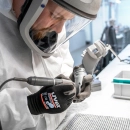
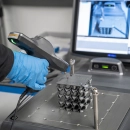
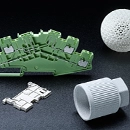








In the glossary, you will find the most important terms related to industrial 3D printing – explained in a compact and easy-to-understand way. Select a letter to quickly find relevant technical terms.
Additive Manufacturing
Additive manufacturing describes processes in which components are built layer by layer from digital 3D data.
Unlike conventional methods, material is not removed but added selectively.
Aluminum
Aluminum is a lightweight metal commonly used in industrial 3D printing.
It is suitable for applications requiring high strength combined with low weight.
ABS (Acrylonitrile Butadiene Styrene)
ABS is a widely used thermoplastic in 3D printing. It is durable, impact-resistant, and often used for functional components.
Build volume
The build volume describes the maximum size a component can have within a 3D printer.
It defines the printable space available.
Build platform
The build platform is the surface on which a component is created during printing. Proper adhesion is important for achieving a stable and accurate print result.
CAD (Computer-Aided Design)
CAD describes digital design data used to create 3D models for manufacturing.
It forms the basis for all additive manufacturing processes.
CNC post-processing
CNC post-processing refers to machining steps such as milling or drilling that are applied after 3D printing.
These processes improve dimensional accuracy and surface quality.
Copper
Copper is a metal with excellent thermal and electrical conductivity.
It is used in additive manufacturing for applications requiring efficient heat transfer, such as inductors.
Cooling channels
Cooling channels are integrated structures within a component that allow liquids or air to flow through.
They help regulate temperature and improve performance in technical applications.
Curing
Curing describes the hardening of materials, typically by exposure to light or heat.
It is commonly used in resin-based 3D printing processes.
Chemical smoothing
Chemical smoothing is a post-processing technique used to improve surface quality by slightly dissolving and leveling the outer layer of a component.
Data preparation
Data preparation refers to checking and optimizing a
3D file before printing.
It ensures that the model can be manufactured correctly and without errors.
Dimensional accuracy
Dimensional accuracy describes how closely a printed component matches the intended dimensions. It depends on the material, printing process, and preparation of the data.
End-use part
An end-use part is a component that is fully functional and ready for its final application.
In additive manufacturing, such parts can often be produced directly without additional tooling.
Epoxy resin
Epoxy resin is a material used in resin-based 3D printing processes.
It allows the creation of components with very smooth surfaces and fine details.
Extruder
The extruder is a key component of a 3D printer. It melts the printing material and deposits it layer by layer to form the final part.
FDM (Fused Deposition Modeling)
FDM is a 3D printing process in which thermoplastic material is melted and deposited layer by layer to build a component.
It is one of the most widely used additive manufacturing technologies.
Filament
Filament is the raw material used in FDM printing. It is supplied as a plastic strand on a spool and fed into the extruder during the printing process.
Granulate
Granulate is a material in the form of small plastic pellets.
It is used as raw material in various manufacturing processes and can also be applied in additive manufacturing.
Generative manufacturing
Generative manufacturing describes processes in which components are built layer by layer. The term is often used as a synonym for additive manufacturing or 3D printing.
Hybrid manufacturing
Hybrid manufacturing combines additive manufacturing processes with conventional methods such as machining.
This allows the production of complex geometries along with high precision finishing.
Heated bed
A heated bed is a build surface that is actively heated during 3D printing.
It improves adhesion of the component and reduces warping during cooling.
Heated print bed
A heated print bed is a specific type of heated build platform used mainly in FDM printing.
It ensures consistent temperature distribution and helps prevent deformation of the printed part.
Hollow structure
A hollow structure describes components whose interior is intentionally left empty or reduced. This decreases weight and material usage while maintaining sufficient structural stability.
Infill
Infill refers to the internal structure of a 3D‑printed component.
It influences the strength, weight, and material consumption of the part.
Inductors
Inductors are components used to heat metal in a controlled way.
They are applied in industrial processes where workpieces need to be heated efficiently and precisely without direct contact.
Injection molding
Injection molding is a manufacturing process in which liquid material is injected into a mold to produce parts. It is widely used for high-volume production of plastic components.
Jetting processes
Jetting processes are additive manufacturing methods in which materials are applied in droplets and then cured.
They are known for high precision and excellent surface quality.
Job
A job refers to a single print task or order in 3D printing.
It defines the production of one or multiple components within a specific process run.
Just-in-time
Just-in-time is a production concept where components are manufactured exactly when they are needed. Additive manufacturing supports this approach by enabling fast and flexible production.
Laser sintering (SLS)
Laser sintering is a 3D printing process in which powdered material is fused layer by layer using a laser.
It is widely used for producing functional and complex plastic components.
Layer height
Layer height describes the thickness of a single layer in the printing process.
It influences the surface quality, level of detail, and production time.
Lightweight design
Lightweight design refers to reducing the weight of a component while maintaining its structural performance. Additive manufacturing enables optimized geometries that save material and improve efficiency.
Machining
Machining is a conventional manufacturing process in which material is removed using techniques such as milling or turning.
It is often combined with additive manufacturing in hybrid production.
Mass customization
Mass customization describes the production of individually adapted products in larger quantities.
Additive manufacturing enables flexible design adjustments without the need for new tools.
Metal 3D printing
Metal 3D printing refers to additive manufacturing processes that produce components from metallic materials.
These parts are highly durable and used in demanding industrial applications.
Multi Jet Fusion (MJF)
Multi Jet Fusion is a powder-based 3D printing process for plastics. It enables the fast production of functional parts with high detail and good mechanical properties.
Nozzle
The nozzle is a key component of a 3D printer through which the material is extruded.
It determines the precision and thickness of the printed layers.
Nesting
Nesting describes the optimized arrangement of multiple parts within the build volume of a printer.
This maximizes space utilization and improves production efficiency.
Nylon (PA)
Nylon (polyamide) is a widely used plastic in additive manufacturing. It offers high strength, flexibility, and durability, making it ideal for functional components.
Overhang
Overhang refers to areas of a component that are printed without direct support underneath.
Depending on the manufacturing process, support structures may be required to ensure stability.
On-demand production
On-demand production means that components are manufactured only when they are needed.
This reduces storage costs and enables flexible, demand-driven production.
Oxidation
Oxidation is a chemical reaction in which a material reacts with oxygen. In metals, this can lead to corrosion or changes in surface properties.
Powder
Powder is a raw material used in various additive manufacturing processes such as laser sintering.
It is spread layer by layer and selectively fused to form a component.
PolyJet
PolyJet is a 3D printing process in which liquid photopolymers are applied in droplets and cured using light.
It is known for high resolution and smooth surface quality.
Prototyping
Prototyping refers to the creation of initial models to test design and functionality.
Additive manufacturing allows prototypes to be produced quickly and cost-effectively.
Plastic
Plastics are widely used materials in 3D printing.
They offer a good balance of strength, flexibility, and ease of processing.
Printing processes
Printing processes describe the different methods used in additive manufacturing to build components layer by layer. These include technologies such as FDM, SLS, and SLA.
Quality assurance
Quality assurance includes all measures taken to ensure that a component meets defined requirements.
In additive manufacturing, this includes checking dimensions, material properties, and surface quality.
Quality control
Quality control refers to the inspection and verification of finished components. It ensures that the produced parts comply with specifications and standards.
Rapid prototyping
Rapid prototyping refers to methods that enable the fast production of prototypes directly from digital data.
It is widely used in additive manufacturing to test designs and functionality at an early stage.
Rapid manufacturing
Rapid manufacturing describes the production of finished components using additive processes.
In this case, the parts are used as end-use products rather than just prototypes.
Resin
Resin is a liquid material used in processes such as stereolithography (SLA). It hardens when exposed to light and enables high-detail and smooth-surface components.
SLS (Selective Laser Sintering)
SLS is a 3D printing process in which powdered material is fused layer by layer using a laser.
It is suitable for producing durable and complex plastic components without support structures.
SLA (Stereolithography)
SLA is an additive manufacturing process in which liquid resin is cured layer by layer using light.
It enables very fine details and smooth surfaces.
SLM (Selective Laser Melting)
SLM is a metal 3D printing process in which metallic powder is fully melted by a laser.
It produces dense and highly durable metal components.
Slicing
Slicing is the process of converting a 3D model into individual layers.
These layers define how the printer builds the component step by step.
STL (Standard Triangulation Language)
STL is a common file format in 3D printing that describes the geometry of a 3D model using triangles. It does not contain information about material or color.
Thermoplastics
Thermoplastics are materials that become soft and moldable when heated and harden again when cooled.
They are widely used in additive manufacturing due to their versatility and ease of processing.
TPU (Thermoplastic Polyurethane)
TPU is a flexible thermoplastic material used in 3D printing.
It is suitable for components that require elasticity, impact resistance, and durability.
Topology optimization
Topology optimization is a design method used to reduce material usage while maintaining structural strength. It is particularly effective in additive manufacturing for creating lightweight and efficient components.
Upload
Upload refers to submitting a digital 3D model to a platform or system in order to analyze, configure, or manufacture the component.
UV curing
UV curing is a process in which liquid material hardens when exposed to ultraviolet light. It is commonly used in resin-based 3D printing to solidify components layer by layer.
Vacuum casting
Vacuum casting is a manufacturing process in which liquid material is poured into a mold under vacuum conditions.
It is used to produce small series of plastic parts with high detail accuracy.
Volume
Volume describes the total space occupied by a component. In 3D printing, it is often used to calculate material usage and production cost.
Warping
Warping refers to the unwanted distortion of a component during or after the printing process.
It is typically caused by uneven cooling or internal stresses in the material.
Workpiece
A workpiece is the object or component being manufactured. In additive manufacturing, the workpiece is built layer by layer from digital data.
Didn’t find the answer you were looking for?
We are happy to support you personally with your request. Contact us directly – our team will advise you on materials, processes, and your specific project.
PROTIQ GmbH
Flachsmarktstraße 54
32825 Blomberg
Phone: +49 (0) 5235 3-43800
Fax: +49 (0) 5235 3-441154
Email: service@protiq.com