


 Deutsch
 English
 Italiano

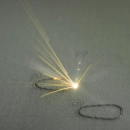
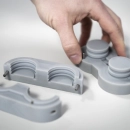
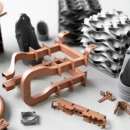
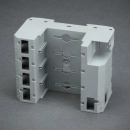
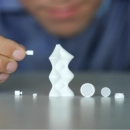
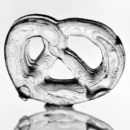











Hot Lithography: 3D Printing with Heated High-Performance Resins
Hot Lithography is a laser-based 3D printing process developed by the Austrian company Cubicure. According to the manufacturer, a patented heating and coating technology heats high-viscosity photopolymers to up to 120 °C and applies them as a thin layer, and a laser cures them layer by layer. This makes it possible to process resins that are too viscous at room temperature for classic stereolithography.
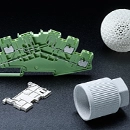
These high-performance resins enable parts with special properties – depending on the material, for example flame-retardant (UL 94 V-0 at the stated specimen thickness), electrically insulating or with high heat deflection temperature. Typical fields of application are electronic components such as coil formers and connectors, precision parts as well as prototypes and series parts. Via the PROTIQ Marketplace, you can order or request Hot Lithography parts directly – depending on the current offer.
Hot Lithography at a glance
- Process principle
- Laser-based photopolymerization with heated resin
- Materials
- high-viscosity photopolymers, very viscous at room temperature
- Layer thickness
- 50–100 µm
- Minimum wall thickness
- from 0.3 mm
- Quantity
- Single part to series
Guide values, not guaranteed properties; the information provided by the supplier in the quote is authoritative.
How it works
How does Hot Lithography work?
The resin is heated until it flows sufficiently and is applied as a thin layer by a heated coating unit. A laser traces the cross-section of the part and cures the resin there. The build platform then moves on by one layer thickness, a new layer is applied and the process repeats. Precise temperature control is crucial: the resin must be warm enough to be processed, while temperature peaks and local overheating must be avoided.
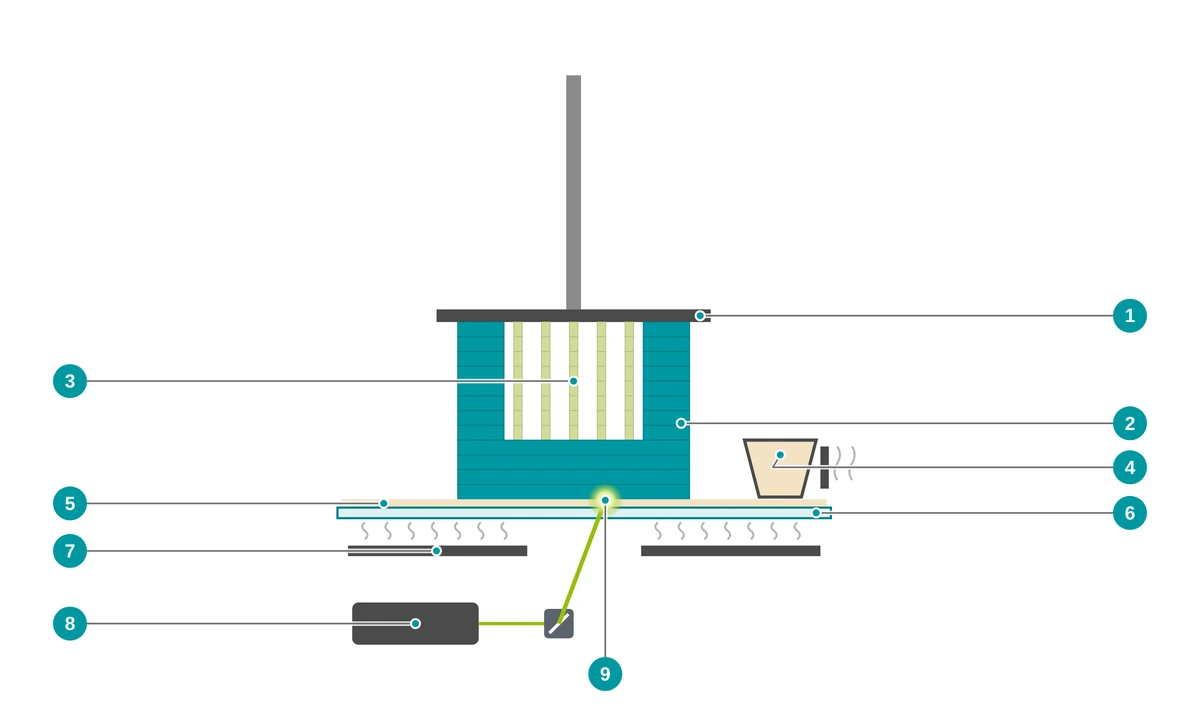
- 1 Build platform – moves on after each layer
- 2 Part, built layer by layer
- 3 Support structures – removed after printing
- 4 Heated coating unit applies a thin layer of resin
- 5 High-viscosity resin
- 6 Transparent material carrier
- 7 Heating keeps the resin at processing temperature
- 8 Laser with scanner
- 9 The laser cures the current layer
- Prepare data The 3D model is oriented, provided with support structures and sliced into layers.
- Heat resin The high-viscosity resin is brought to its processing temperature – up to 120 °C depending on the material.
- Apply layer The heated coating unit spreads the resin into an even, thin layer.
- Expose A laser cures the resin along the cross-section. Then the next layer follows.
- Clean and remove supports The finished part is cleaned of adhering resin and the support structures are removed.
- Post-cure If the material requires it, the part is post-cured and thus achieves its final properties.
Hot Lithography or SLA?
What is the difference between Hot Lithography and stereolithography?
Both processes cure photopolymers with a laser. The difference lies in the material: stereolithography processes liquid resins, while Hot Lithography heats high-viscosity resins that would be too viscous at room temperature. This makes material formulations possible that cannot be processed with classic SLA machines.
| Hot Lithography | Stereolithography (SLA) | |
|---|---|---|
| Starting material | high-viscosity photopolymers, very viscous at room temperature | liquid photopolymers |
| Processing | heated, up to 120 °C | usually at room temperature |
| Exposure | Laser | mostly laser |
| Materials | High-performance resins, depending on the material flame-retardant, electrically insulating or with high heat deflection temperature | tough, transparent and temperature-resistant resins |
| Support structures | usually required | required |
| Typical use | Electronic components, precision and functional parts, series parts | Design and functional prototypes, transparent parts, master models |
Advantages
What are the advantages of Hot Lithography?
Hot Lithography combines a laser-based resin process with materials for technical requirements – such as flame retardancy, electrical insulation or high temperatures.
High-performance resins
Heating makes it possible to process high-viscosity resins that cannot be printed with classic SLA machines.
Flame-retardant
THERMOBlast and ConnectionFR achieve UL 94 V-0 – at a specimen thickness of 0.45 mm and 1.5 mm respectively.
High heat deflection temperature
THERMOBlast achieves a heat deflection temperature (HDT-B) of over 300 °C.
Electrically insulating
THERMOBlast and ConnectionFR have a comparative tracking index (CTI) of 600 V and a dielectric strength of 30 and 31 kV/mm respectively.
Fine structures
Wall thicknesses from 0.3 mm and layer thicknesses of 50–100 µm are possible.
From no tooling to series
No tooling, no mold costs – from prototype to series production, which the supplier also offers.
Materials
Which materials are available for Hot Lithography?
Hot Lithography processes high-performance photopolymers that are very viscous at room temperature. These include EvolutionHI, THERMOBlast, ConnectionFR and Precision, among others.
We will be happy to clarify with you and the supplier which materials are suitable for your part.
EvolutionHI
Versatile material with high impact strength – for example for electronics, tooling and mobility.
THERMOBlast
High-temperature material for special applications – for example for electronics, aerospace and medical technology.
ConnectionFR
Flame-retardant material for the electronics industry – for example for connectors.
Precision
Material for precision applications – for example for fluid technology, medical technology and end products.
Material data compared
| Material | Tensile strength (MPa) | Young’s modulus (MPa) | Elongation at break (%) | Heat deflection temperature HDT-B (°C) | UL 94 (specimen thickness) |
|---|---|---|---|---|---|
| EvolutionHI | 53 | 2,150 | 35 | 80 | HB (1 mm) |
| THERMOBlast | 90 | 5,000 | 2.4 | > 300 | V-0 (0.45 mm) |
| ConnectionFR | 47 | 2,700 | 5 | 118 | V-0 (1.5 mm) |
| Precision | 68 | 2,700 | 7 | 90 | – |
Values according to the supplier. Not guaranteed properties; the values may depend on post-treatment, part geometry and build orientation, among other factors. The heat deflection temperature (HDT-B, 0.45 MPa) is not a continuous service temperature. The UL 94 classification applies to standardized test specimens of the stated thickness, not to the finished part. For Precision, the supplier lists the standards ISO 10993-5:2009 and ISO 10993-23:2021 under biocompatibility; no test results are given there. This is not an approval for a specific medical application. Whether a UL listing exists must be checked with the supplier.
Hot Lithography and the material names mentioned may be trademarks of their respective owners. They are mentioned only to describe the process and the materials.
↑ Back to overviewTechnical data
Technical data and design guidelines
Hot Lithography works with layer thicknesses of 50–100 µm; wall thicknesses from 0.3 mm are possible. The maximum part size depends on the machine.
| Feature | Value |
|---|---|
| Maximum part size | depending on the supplier’s machine |
| Layer thickness | 50–100 µm |
| Minimum wall thickness | from 0.3 mm |
| Processing temperature | up to 120 °C |
| Support structures | usually required |
| Post-processing | Cleaning, removing supports, post-curing depending on the material |
Guide values, not guaranteed properties. The information provided by the supplier in the quote is authoritative.
What to consider when designing
- Choose the material according to requirements Determine early on what matters – flame retardancy, temperature, electrical insulation or impact strength. The material depends on this.
- Flame retardancy and wall thickness The UL 94 classification applies to the stated specimen thickness. Whether your part meets the requirements must be checked on a case-by-case basis.
- Observe minimum wall thickness Walls below 0.3 mm are not intended. Plan a reserve for load-bearing structures.
- Cavities with openings Resin can remain in closed cavities. Provide openings so that the part can be cleaned.
- Specify visible surfaces Small marks may remain at the support points. Specify visible surfaces in your request so that they can be taken into account where possible.
- Test under real conditions Test parts under realistic conditions before using them in series.
Limits & alternatives
When is another process the better choice?
- Part size The maximum part size depends on the machine. For very large parts, another process may make more sense.
- Post-processing Cleaning and removing the support structures are part of the process.
- UV resistance We do not have any information on UV and weather resistance for these materials. Whether a part can be used outdoors permanently must be clarified with the supplier on a case-by-case basis.
- Medical applications References to tests according to ISO 10993 are not an approval for a specific application; suitability must be clarified on a case-by-case basis.
| Process | Strengths | May be the better choice if … |
|---|---|---|
| Stereolithography (SLA) | Smooth parts with fine details, depending on the resin also transparent | … you need design and demonstration models or transparent parts |
| CLIP process | Resin process with rigid, tough, flame-retardant and elastic resins | … you need elastic parts or lattice structures |
| Laser sintering (SLS) | Resilient parts without support structures, depending on the supplier also flame-retardant | … your part is larger or should be produced without support structures |
| Injection molding | Cost-effective for large quantities | … the quantity is so large that a tool pays off |
Applications
What is Hot Lithography used for?
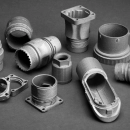
Hot Lithography is used for coil formers, connectors and other electronic components, precision parts for fluid technology and medical technology as well as functional parts for mobility and mechanical engineering, among others.

Series production
Electronic components and functional parts in series – without tooling, made of high-performance resins.
To series production
Prototyping
Functional prototypes made of high-performance resins – to test form, fit and function early on.
To prototyping
Medical technology
Precision parts and prototypes. Whether a material is suitable for a medical application must be clarified on a case-by-case basis.
To medical technologyOrdering
How do I order Hot Lithography parts?
Depending on the current offer, Hot Lithography can be selected directly in the configurator or is available on request. Upload your 3D file – or write to us and we will put you in touch with the supplier.
- Upload file Upload your 3D data in the configurator. The system automatically checks whether the part fits into the build space.
- Choose material Choose from more than 160 materials and more than 12 processes.
- Check the offer As a rule, you immediately see the price and production time of the available suppliers.
- Order or request You order directly online at the selected price – or request Hot Lithography through us.
FAQ
Frequently asked questions about Hot Lithography
What is Hot Lithography?
Hot Lithography is a laser-based 3D printing process developed by the Austrian company Cubicure. High-viscosity photopolymers are heated to up to 120 °C, applied as a thin layer and cured layer by layer with a laser.
What is the difference from stereolithography?
Both cure photopolymers with a laser. However, Hot Lithography heats high-viscosity resins that would be too viscous at room temperature for classic stereolithography. This also makes it possible to process materials such as the flame-retardant or particularly heat-resistant resins mentioned here.
Which materials are available for Hot Lithography?
Materials for Hot Lithography include EvolutionHI (impact-resistant), THERMOBlast (high heat deflection temperature, flame-retardant), ConnectionFR (flame-retardant, for electronics) and Precision (for precision applications).
Are there flame-retardant materials?
Yes. THERMOBlast and ConnectionFR achieve UL 94 V-0 at a specimen thickness of 0.45 mm and 1.5 mm respectively. The classification applies to standardized test specimens; whether your part meets the requirements must be checked on a case-by-case basis.
How heat-resistant are the parts?
That depends on the material. The heat deflection temperature (HDT-B) ranges from 80 °C for EvolutionHI to over 300 °C for THERMOBlast. The heat deflection temperature is not a continuous service temperature.
How fine can structures be?
Wall thicknesses from 0.3 mm and layer thicknesses of 50–100 µm are possible.
How large can the parts be?
That depends on the supplier’s machine. If Hot Lithography can be selected in the configurator, the system automatically checks whether your part fits into the build space when you upload. Otherwise, we will be happy to clarify the part size with the supplier.
How much does a Hot Lithography part cost?
The price depends on factors such as part volume, size, material and quantity. Upload your file or write to us for a quote.