


 Deutsch
 English
 Italiano
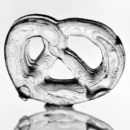







Glass 3D Printing (LGM): Transparent Parts Made of Fused Silica
In glass 3D printing with Lithography-based Glass Manufacturing (LGM), parts are made of fused silica. On the PROTIQ Marketplace, the process is based on Glassomer technology: a liquid composite of fine glass powder and light-curing organic binder is exposed layer by layer using stereolithography. The printed green part is then debound and sintered – creating a part made of real glass.
Because the shape is created by 3D printing, complex geometries – including channels and cavities with openings – can be produced without tooling. The sintered fused silica is transparent, has a maximum service temperature of 1,000 °C and hardly expands when heated. Glass 3D printing is therefore suitable for prototypes, single parts and small batches made of glass that could only be produced conventionally with great effort.
Glass 3D printing at a glance
- Process principle
- Stereolithographic exposure of a liquid glass composite, followed by debinding and sintering into glass
- Material
- Fused silica, purity 99.9 %
- Max. part size
- 164 × 90 × 150 mm
- Wall thickness
- 0.8 to 5 mm
- Quantity
- 1 to 10,000 pieces per year, depending on geometry
Guide values, not guaranteed properties. The information provided by the supplier in the ordering process or in the quote is authoritative.
How it works
How does glass 3D printing work?
The starting material is a liquid composite of fine glass powder and a light-curing organic binder. It is exposed layer by layer using stereolithography; the binder cures in the exposed areas – creating a whitish, opaque green part. At around 600 °C the binder is removed (debinding), and at around 1,300 °C the glass particles densify into dense, transparent fused silica (sintering).
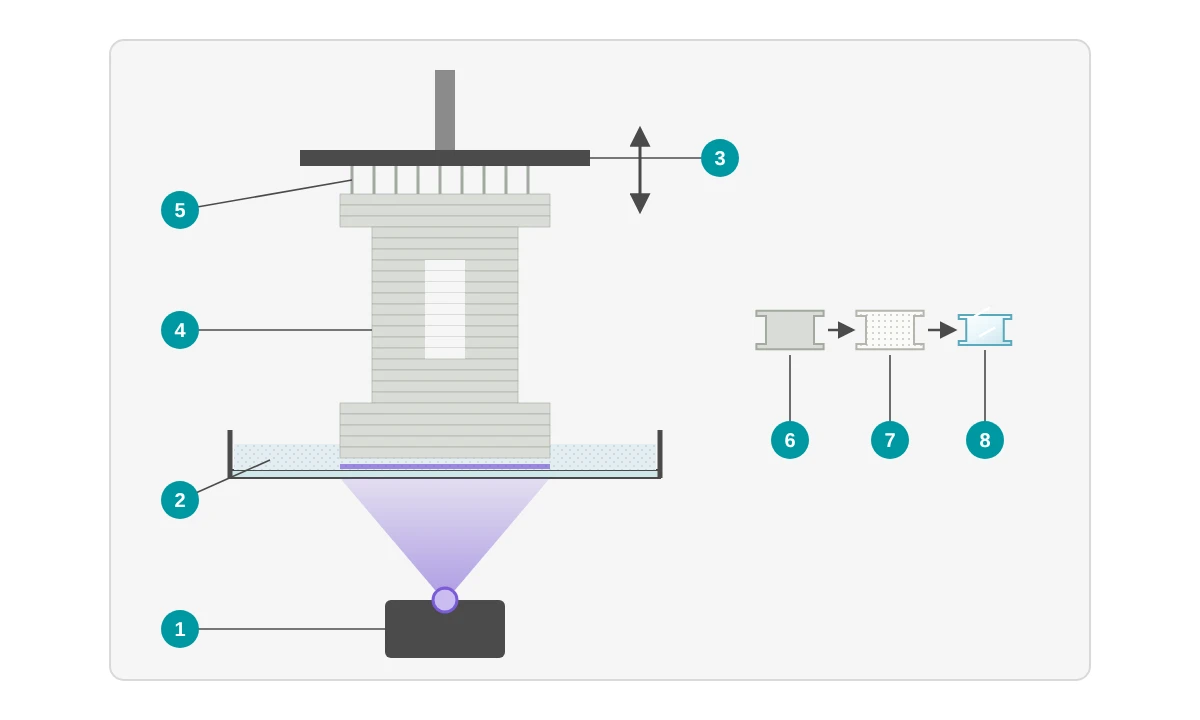
- 1 Light source (e.g. projector) exposes the cross-section, here from below through the transparent vat bottom
- 2 Vat with liquid composite of glass powder and light-curing binder
- 3 Build platform dips into the material and rises again after exposure
- 4 Green part: glass particles in cured binder, whitish and opaque, here built upside down on the platform
- 5 Support structures connect the part and the build platform
- 6 Green part after printing
- 7 Debinding at around 600 °C: the binder is removed, leaving a porous glass body
- 8 Sintering at around 1,300 °C: the glass particles densify into transparent fused silica, the part shrinks uniformly
- Prepare data The 3D model is oriented, provided with support structures, scaled up to compensate for sintering shrinkage and sliced into layers.
- Printing The cross-section is exposed layer by layer, and the composite cures in these areas.
- Clean the green part The green part is removed from the build platform and freed from excess material. It behaves similarly to plastic, so support structures can be removed easily.
- Debinding In a furnace, the binder is removed at around 600 °C. What remains is a porous body of glass particles.
- Sintering At around 1,300 °C, the glass particles densify into dense, transparent fused silica. The shape is retained and the part shrinks uniformly in all directions – the shrinkage is factored in during data preparation.
- Surface Without coating, the printed layers remain visible on the surface. A coating smooths the surface and increases transparency, but reduces dimensional accuracy.

3D printing or conventional?
When is glass 3D printing worthwhile instead of conventional glass processing?
Conventionally, fused silica parts are ground, drilled and polished from semi-finished products or hot-formed at very high temperatures – this is complex, and complex internal geometries are hardly possible. Glass 3D printing builds the part directly from the 3D data. This is particularly worthwhile for complex geometries, prototypes and small quantities.
| Glass 3D printing | Conventional glass processing | |
|---|---|---|
| Tooling | no mold and no tool required | mold, tool or complex machining required |
| Geometry | complex shapes, including channels and cavities with openings, possible | limited by tooling, grinding and forming |
| Dimensional accuracy | ± 250 µm (uncoated), ± 500 µm (coated) | very tight tolerances possible by grinding and polishing |
| Quantity | 1 to 10,000 pieces per year, depending on geometry | shaping with tooling is cost-effective mainly for large quantities; single parts require complex machining |
Which route suits your part better depends on geometry, size, accuracy and quantity. Upload your file and see the available offers in the configurator – or contact us if you would like to discuss your project.
↑ Back to overviewAdvantages
What are the advantages of glass 3D printing?
Glass 3D printing combines the design freedom of 3D printing with the properties of fused silica: transparent, temperature-resistant and resistant to most chemicals.
Real fused silica
After sintering, the part consists of fused silica with a purity of 99.9 %.
Transparent
The parts are transparent. A coating smooths the surface and further increases transparency.
Temperature-resistant
The maximum service temperature of the sintered fused silica is 1,000 °C.
Hardly any thermal expansion
At 0.52 · 10−6/K, the coefficient of thermal expansion is close to zero.
Resistant and clear in the long term
Fused silica is resistant to most acids and solvents and stays clear in the long term without yellowing – unlike many transparent plastics.
Complex shapes without tooling
Channels and cavities with openings as well as free-form shapes are created directly from the 3D data – feasibility depends on length and diameter.
Material
What glass are 3D-printed glass parts made of?
On the PROTIQ Marketplace, glass 3D printing offers parts made of fused silica with a purity of 99.9 %. They are manufactured using Glassomer technology.
Fused silica consists almost entirely of silicon dioxide. It is hard, temperature-resistant, resistant to most acids and solvents and hardly expands when heated. However, hydrofluoric acid and strong alkalis attack fused silica. You can see which options are currently available in the configurator after uploading – where you will also find the supplier’s datasheet.
Material data of 3D-printed fused silica
| Property | Value |
|---|---|
| Glass type / purity | Fused silica / 99.9 % |
| Density | 2.2 g/cm³ |
| Vickers hardness | 980 HV |
| Flexural strength | 115 MPa |
| Coefficient of thermal expansion | close to zero (0.52 · 10−6/K) |
| Max. temperature | 1,000 °C |
Values from the datasheet on the PROTIQ Marketplace (as of 11/2024); they do not constitute guaranteed properties. The values depend on process control and part geometry. The supplier’s information is authoritative.
↑ Back to overviewTechnical data
Which technical data and design rules apply to glass 3D printing?
Glass parts can be up to 164 × 90 × 150 mm in size. The wall thickness is between 0.8 and 5 mm, and holes are possible from a diameter of 0.7 mm. Tolerances are ± 250 µm for uncoated and ± 500 µm for coated parts.
| Feature | Value |
|---|---|
| Max. part size | 164 × 90 × 150 mm (X × Y × Z); when you upload, the system automatically checks whether the part fits into the build space |
| Wall thickness | min. 0.8 mm, max. 5 mm |
| Holes | Diameter from 0.7 mm |
| Tolerances uncoated | ± 250 µm (X, Y, Z) |
| Tolerances coated | ± 500 µm (X, Y, Z) |
| Surface uncoated | highest dimensional accuracy, printed layers remain visible |
| Surface coated | smooth surface and higher transparency, lower dimensional accuracy |
| Quantity | 1 to 10,000 pieces per year, depending on geometry |
| File formats | STL, STEP |
Values from the datasheet on the PROTIQ Marketplace (as of 11/2024). Tolerances may change depending on part geometry. The information provided by the supplier in the ordering process or in the quote is authoritative.
How long can overhangs be without support?
How long an overhang can be without a support structure depends on its angle α to the horizontal: the flatter the overhang, the shorter it must be.
| Angle α to the horizontal | Max. overhang length L without support |
|---|---|
| below 30° | 1 mm |
| 30° to below 50° | 15 mm |
| 50° to 90° | 40 mm |
What to consider when designing
- Observe wall thickness Plan walls between 0.8 and 5 mm. Thinner walls are not intended; you should split or hollow out bulkier areas.
- Limit overhangs Flat overhangs are only possible for short lengths without support. Steeper surfaces (50° to 90°) may overhang by up to 40 mm.
- Holes not too small Holes and channels should have a diameter of at least 0.7 mm and have openings so that excess material can be removed.
- Choose the surface according to purpose If dimensional accuracy is important, uncoated is the better choice. For smooth surfaces that are as transparent as possible, the coating makes sense.
- Radii instead of sharp edges Glass is hard but brittle. Sharp edges and notches act as weak points – plan radii on edges and inside corners.
- Clarify functional surfaces For fits or optical requirements, please contact us before ordering – depending on requirements, post-processing may be necessary.
Limits & alternatives
When is another process the better choice?
- Dimensional accuracy With ± 250 µm (uncoated) or ± 500 µm (coated), glass 3D printing is not suitable for very tight tolerances without post-processing.
- Part size and wall thickness Parts are limited to 164 × 90 × 150 mm and wall thicknesses of 0.8 to 5 mm. Solid glass parts are not possible.
- Surface Without coating, the printed layers remain visible. For optical applications with high surface requirements, please clarify suitability with us in advance.
- Brittleness Glass is hard but brittle. For parts subject to shock or impact loads, other materials are usually better suited.
| Process | Strengths | May be the better choice if … |
|---|---|---|
| Ceramic 3D printing (LCM) | Parts made of technical ceramics with high strength and hardness | … strength and hardness are more important than transparency |
| Stereolithography (SLA) | Fine details and smooth surfaces in plastic | … a plastic prototype or demonstration model is sufficient |
Lithography-based Glass Manufacturing (LGM) and other process, material, brand and company names mentioned are trademarks or designations of their respective owners. They are mentioned only to describe the process or materials.
↑ Back to overviewApplications
What is glass 3D printing used for?
Glass 3D printing can be suitable for parts where transparency, temperature resistance or chemical resistance is required – for example for glass prototypes such as bottle and packaging designs that are to be tested without expensive glass molds, for functional parts, components in research and development, and for design objects, art and jewelry. Fused silica is also used in fields such as medical technology.
↑ Back to overviewOrdering
How do I order 3D-printed glass parts?
Upload your 3D file, choose material and process and see the available offers.
- Upload file Upload your 3D data in the configurator. The system automatically checks whether the part fits into the build space.
- Choose material Choose from more than 160 materials and more than 12 processes – for example fused silica with glass 3D printing.
- Check the offer As a rule, you immediately see the price and production time of the available suppliers.
- Order You order directly online at the selected price.
If an option cannot be selected directly, feel free to ask us.
↑ Back to overviewFAQ
Frequently asked questions about glass 3D printing
How does glass 3D printing work?
A liquid composite of glass powder and light-curing binder is exposed layer by layer using stereolithography. The printed green part is then debound at around 600 °C and sintered into dense fused silica at around 1,300 °C.
Can fused silica be produced by 3D printing?
Yes. After sintering, the part consists of fused silica with a purity of 99.9 %. The binder from printing is removed thermally during debinding.
How large can 3D-printed glass parts be?
Up to 164 × 90 × 150 mm. When you upload, the system automatically checks whether your part fits into the build space.
How accurate are 3D-printed glass parts?
Tolerances are ± 250 µm for uncoated and ± 500 µm for coated parts. They may vary depending on geometry.
How transparent are 3D-printed glass parts?
The parts are transparent. Without coating, the printed layers remain visible on the surface. Coated parts achieve the highest transparency but are less dimensionally accurate.
What wall thicknesses are possible in glass 3D printing?
The wall thickness is between 0.8 and 5 mm. Holes are possible from a diameter of 0.7 mm.
How much does a 3D-printed glass part cost?
The price depends on factors such as part volume, size, surface finish and quantity. After uploading your file, you will usually see the suppliers’ prices immediately in the configurator.