


 Deutsch
 English
 Italiano










3D-Printed Heat Exchangers
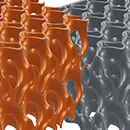
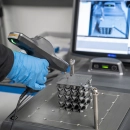
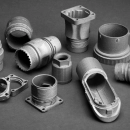
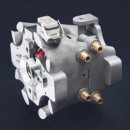
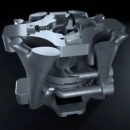
3D printing produces heat exchangers and heat sinks with internal channels, gyroid and lattice structures that can hardly or not at all be manufactured by milling, brazing or bending. The result: more surface area for heat transfer in less installation space. They are manufactured by selective laser melting (SLM) – mainly from copper or aluminum.
Because no tooling is required, 3D printing pays off even for prototypes, functional samples, one-offs and small batches. On the PROTIQ Marketplace, you upload your 3D data, choose the material and compare offers – PROTIQ is itself one of the manufacturers.

- 415 ± 10 W/(m·K)thermal conductivity of pure copper
- 103 ± 5 W/(m·K)thermal conductivity of AlSi10Mg
- 2.67 g/cm³density of AlSi10Mg – pure copper: 8.9 g/cm³
- since 2013PROTIQ has been 3D printing copper
Basics
What are heat exchangers – and why 3D print them?
Heat exchangers transfer thermal energy between two media in order to cool or heat systems in a targeted way. Conventionally, they are milled, welded, brazed or bent – but with complex internal structures, which are decisive for good heat transfer, these processes quickly reach their limits.
3D printing builds the part layer by layer. This allows channels, surfaces and wall thicknesses to be designed according to function rather than the limits of the tool – including numerically optimized geometries.
| Conventional manufacturing | 3D printing | |
|---|---|---|
| Production | Milling, welding, brazing or bending, often from several individual parts | Selective laser melting directly from CAD data, often in one piece |
| Internal structures | Straight bores and simple channels | Freeform channels, gyroid and lattice structures |
| Joints | Brazed or welded joints between the individual parts | Fewer or no joints |
| Tooling | Sometimes required, variants are complex | None – every variant is produced directly from the data |
| Cost-effective from | larger quantities | one-off, prototype and small batch |

Structures
Which structures make 3D-printed heat exchangers efficient?
What matters is a large surface area combined with good flow guidance. 3D printing makes this possible with gyroid and lattice structures, freeform channels as well as fins and pins in geometries that cannot be produced conventionally.
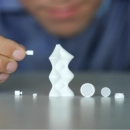
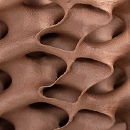
- Gyroid structures: This mathematically defined surface divides the space into two intertwined, separate channel systems – ideal for guiding two media past each other in a confined space.
- Lattice structures: Fine, open lattices increase the surface area with little material use and low weight.
- Freeform channels: Cooling channels follow the contour of the heat source and can be designed for uniform heat transfer and low pressure drop.
- Fins and pins: Three-dimensionally curved fins or densely arranged pins improve heat transfer to air or liquid.
Materials
Copper or aluminum – which material suits your heat exchanger?
Copper conducts heat around four times as well as the aluminum alloy AlSi10Mg (415 compared with 103 W/(m·K) according to the data sheets) and is the first choice when heat transfer is the priority. At 2.67 g/cm³, aluminum weighs only around a third as much as copper and is ideal when weight matters.
| Material | Thermal conductivity* | Density* | Tensile strength* | Suitable for |
|---|---|---|---|---|
| Pure copper | 415 ± 10 W/(m·K) | 8.9 g/cm³ | 220 ± 10 MPa (as built) | Maximum heat transfer in a small space, for example for cold plates and heat sinks |
| Aluminum (AlSi10Mg) | 103 ± 5 W/(m·K) | 2.67 g/cm³ | 410 ± 20 MPa (as built) | Lightweight heat exchangers and heat sinks when weight matters |
* Values according to the PROTIQ material data sheet, laser-melted.
Besides heat conduction and weight, the medium, corrosion conditions and mechanical load also play a role. You choose the material in the configurator – or contact us directly.
Copper in 3D printing Aluminum in 3D printing
↑ Back to overviewApplications
Where are 3D-printed heat exchangers used?
Wherever high heat loads have to be dissipated in a small installation space and standard solutions do not fit: in power electronics and data centers, in industry and mechanical engineering, in electric drives and battery systems, and in medical technology.
Power electronics and data centers
Power supplies, frequency converters and servers need cooling solutions that are precisely matched to the design and heat source – such as cold plates for liquid cooling. More about data centers
Industry and mechanical engineering
High-performance machines, laser systems or converters require reliable, compact cooling solutions that are precisely adapted to the process requirements.
Electric drives and battery systems
Batteries, power electronics and electric motors must be cooled efficiently – with heat sinks into which the flow channels are directly integrated.
Medical technology
Small, high-performance cooling units for imaging systems, laser devices or portable diagnostic systems – cost-effective even in small quantities.
Benefits
What are the benefits of 3D-printed heat exchangers?
More heat transfer in less installation space, less weight, fewer joints and short development times – from the idea to a functional prototype or series part.
- Higher thermal efficiency: Optimized geometries such as complex channel systems improve heat transfer.
- Great design freedom: Organic shapes, lattice structures and internal cooling channels that can hardly or not at all be produced conventionally.
- Compact design: Less weight and volume without compromising performance – ideal for tight installation spaces.
- Faster development: Short lead times and variants without additional tooling costs.

3D data available
Order a heat exchanger
Upload your CAD data, choose copper or aluminum and compare the offers with price and delivery time.
Upload file nowIdea or optimization
Discuss your project
Do you have an idea or want to improve an existing heat exchanger? We support you from data verification to a ready-to-install part.
Start project requestMaterial
Copper in 3D printing
Pure copper, RS copper and CuCr1Zr – and why copper is so demanding in 3D printing.
More about copperSupport for heat exchangers
We support you throughout the development, optimization, and manufacturing of your heat exchanger, from data validation and design engineering to a ready-to-install component. Together, we develop solutions tailored to your thermal requirements, installation constraints, and performance objectives, guiding your project from the initial concept to the finished part.

FAQ
Frequently asked questions about 3D-printed heat exchangers
What are heat exchangers?
Heat exchangers are components that transfer thermal energy between two media. They are used to cool or heat systems in a targeted way and play a central role in industry, air-conditioning and energy technology.
What are the benefits of 3D printing for heat exchangers?
3D printing enables complex internal channel structures, gyroid and lattice structures and compact designs that can hardly be produced with conventional processes. This improves heat transfer, power density and use of installation space – without tooling and from a quantity of one.
Which materials are used for 3D-printed heat exchangers?
Mainly copper and aluminum. According to the PROTIQ data sheets, pure copper achieves a thermal conductivity of 415 ± 10 W/(m·K) and the aluminum alloy AlSi10Mg 103 ± 5 W/(m·K) at a much lower density (2.67 compared with 8.9 g/cm³).
When is copper better, when aluminum?
Copper is the first choice when as much heat as possible needs to be transferred in a small space. Aluminum is a good option when weight is important and the thermal conductivity of AlSi10Mg is sufficient. The medium, corrosion conditions and mechanical load also influence the choice.
What is a gyroid structure?
A gyroid structure is a mathematically defined, periodic surface that divides the space into two intertwined, separate channel systems. In heat exchangers, this allows two media to be guided past each other in a confined space with a large contact area.
Which process is used to 3D print metal heat exchangers?
Metal heat exchangers are produced by selective laser melting (SLM): a laser selectively melts metal powder layer by layer so that the part is created directly from the CAD data.
What applications are additively manufactured heat exchangers suitable for?
Wherever there are high thermal requirements and custom geometries are needed, for example in power electronics, data centers, mechanical engineering, electric drives and medical technology.
How do I get a 3D-printed heat exchanger?
Upload your 3D data in the configurator, choose the material and compare the offers. If you have questions about design or optimization, send our expert an e-mail.
↑ Back to overview