


 Deutsch
 English
 Italiano








Copper in 3D Printing
Copper conducts electricity and heat better than almost any other technical metal – but in 3D printing it is one of the most demanding materials. PROTIQ has been working on 3D printing with copper since 2013 and today manufactures pure copper parts by selective laser melting (SLM) with an electrical conductivity of up to 59 MS/m.
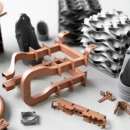
Four copper materials are available on the PROTIQ Marketplace: pure copper, pure copper low-O₂, RS copper and the alloy CuCr1Zr. PROTIQ is itself one of the manufacturers – we produce pure copper, pure copper low-O₂ and RS copper in-house. Typical parts include inductors, heat sinks and heat exchangers with integrated channels, cooling components for data centers and busbars.
- since 2013PROTIQ has been 3D printing copper
- ≤ 59 MS/melectrical conductivity of pure copper
- 415 ± 10 W/(m·K)thermal conductivity of pure copper
- 4 copper materialson the PROTIQ Marketplace
Challenge
Why is copper so demanding in 3D printing?
Copper reflects a large share of the incident laser energy and conducts heat away from the melt zone very quickly. This makes the process window narrow: too little energy leads to incomplete fusion, too much leads to overheating, evaporation and porosity.
- Reflection: While many metals absorb laser energy comparatively well, copper reflects a large share of it. Melting the powder is therefore much more difficult than with stainless steel, for example.
- Heat conduction and geometry: The heat introduced flows quickly into the part. Even differences in geometry, wall thickness or part size change how heat is dissipated – so material, laser system, process control and geometry must be precisely matched.
- Purity and oxidation: Even small impurities or oxygen pick-up can impair the electrical and thermal properties. Controlled powder handling, suitable inert gas atmospheres and consistent quality assurance are therefore essential.
Copper cannot be processed reliably with standard parameters. It takes experience in process development and material control – exactly what PROTIQ has built up over more than a decade of copper 3D printing.
How selective laser melting works
↑ Back to overview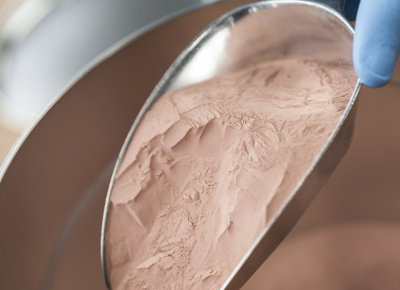
Development
How has copper 3D printing developed at PROTIQ?
For a long time, copper was considered almost impossible to control in laser melting. An early approach was to use copper materials with alloying elements, which are easier to process – at the cost of lower conductivity. PROTIQ has taken this path step by step: from RS copper to pure copper to the particularly low-oxygen pure copper low-O₂.
-
2013
RS copperPROTIQ succeeds in additively processing highly conductive RS copper – a first practical step towards making copper usable for 3D printing, for example for inductors. -
Next
Pure copperWith further developed powder qualities, scan strategies and process parameters, PROTIQ processes 100% pure copper – without alloying elements that reduce conductivity. -
Today
Pure copper low-O₂A coordinated material, process and post-treatment strategy keeps oxygen pick-up as low as possible along the entire process chain.
The focus has shifted as a result: it is no longer just about whether copper can be printed, but about specifically improving the functional properties of the parts.
↑ Back to overviewCopper materials
Which copper materials are available for 3D printing?
On the PROTIQ Marketplace you will find pure copper, pure copper low-O₂, RS copper and CuCr1Zr. For the highest conductivity, pure copper is the first choice, low-O₂ for parts that require particularly high purity. CuCr1Zr offers more strength with lower conductivity.
| Material | Key characteristics | Electrical conductivity* | Thermal conductivity* | Typical parts |
|---|---|---|---|---|
| Pure copper | 100% copper; very high electrical and thermal conductivity, high elongation at break | ≤ 59 MS/m | 415 ± 10 W/(m·K) | Inductors, heat sinks, heat exchangers, busbars |
| Pure copper low-O₂ | Particularly low-oxygen variant of pure copper – for parts that require particularly high purity | on request | on request | Electronics cooling, heat exchangers, current-carrying parts, inductors, low-temperature applications |
| RS copper | PROTIQ's first copper material in 3D printing (since 2013), proven for inductors | 51 MS/m (edge), 32 MS/m (core) |
265 W/(m·K) | Inductors |
| CuCr1Zr | Copper-chromium-zirconium alloy: higher strength and hardness than pure copper, but lower conductivity | on request | on request | Parts that need more strength in addition to conductivity, such as contact parts or electrodes |
* Properties for pure copper low-O₂ and CuCr1Zr are available on request.
Pure copper
Pure copper is the material for parts that conduct electricity or dissipate heat – such as inductors, heat sinks, contact parts or heat exchangers. According to the data sheet, additively manufactured pure copper from PROTIQ achieves an electrical conductivity of up to 59 MS/m and a thermal conductivity of 415 ± 10 W/(m·K). Its conductivity is therefore significantly higher than that of RS copper.
Through the continuous development of powder qualities, scan strategies and process parameters, copper parts are created for demanding electrical and thermal requirements – with the design freedom of additive manufacturing.
- Electrical conductivity≤ 59 MS/m
- Thermal conductivity415 ± 10 W/(m·K)
- Density8.9 g/cm³
- Tensile strength (as built)220 ± 10 MPa
- Yield strength Rp0.2 (as built)140 ± 20 MPa
- Elongation at break (as built)50 ± 10%
Pure copper low-O₂
Pure copper low-O₂ is a particularly low-oxygen variant of pure copper for additive manufacturing – for parts that require particularly high purity. The aim is to keep oxygen pick-up as low as possible along the entire process chain, because even small amounts of oxygen or moisture can promote oxidation in 3D printing and thus affect processing and material properties.
That is why the quality of the starting powder is not the only factor: due to its large surface area, metal powder is particularly sensitive to oxygen and moisture. Storage, powder handling, powder cycles and the conditions during the process also play a role. Pure copper low-O₂ therefore stands for a coordinated material, process and post-treatment strategy developed by PROTIQ.
The material is of interest wherever electrical or thermal conductivity directly determines performance: in electronics cooling, heat exchangers, current-carrying parts and inductors. High purity is also in demand at very low temperatures, where even small impurities can noticeably affect conductivity.
RS copper
With RS copper, PROTIQ entered copper 3D printing in 2013. The material has proven itself above all in inductors for induction heating: according to the data sheet, it achieves an electrical conductivity of 51 MS/m at the edge and 32 MS/m in the core and a thermal conductivity of 265 W/(m·K).
CuCr1Zr
The copper-chromium-zirconium alloy combines good conductivity with higher strength and hardness than pure copper. It is suitable for parts that are subject to greater mechanical loads in addition to requiring conductivity.
- Electrical conductivity (edge / core)51 / 32 MS/m
- Thermal conductivity265 W/(m·K)
- Density8.7–8.9 g/cm³
- Minimum wall thickness0.6 mm
- Wall thickness for media-tight partsfrom 1 mm
- Leak test6 bar compressed air
Applications
What are 3D-printed copper parts used for?
Wherever electricity has to be conducted or heat dissipated and geometry makes the difference: in inductors for induction heating, heat exchangers and heat sinks, cooling components for data centers and electronics, as well as busbars and conductor structures.
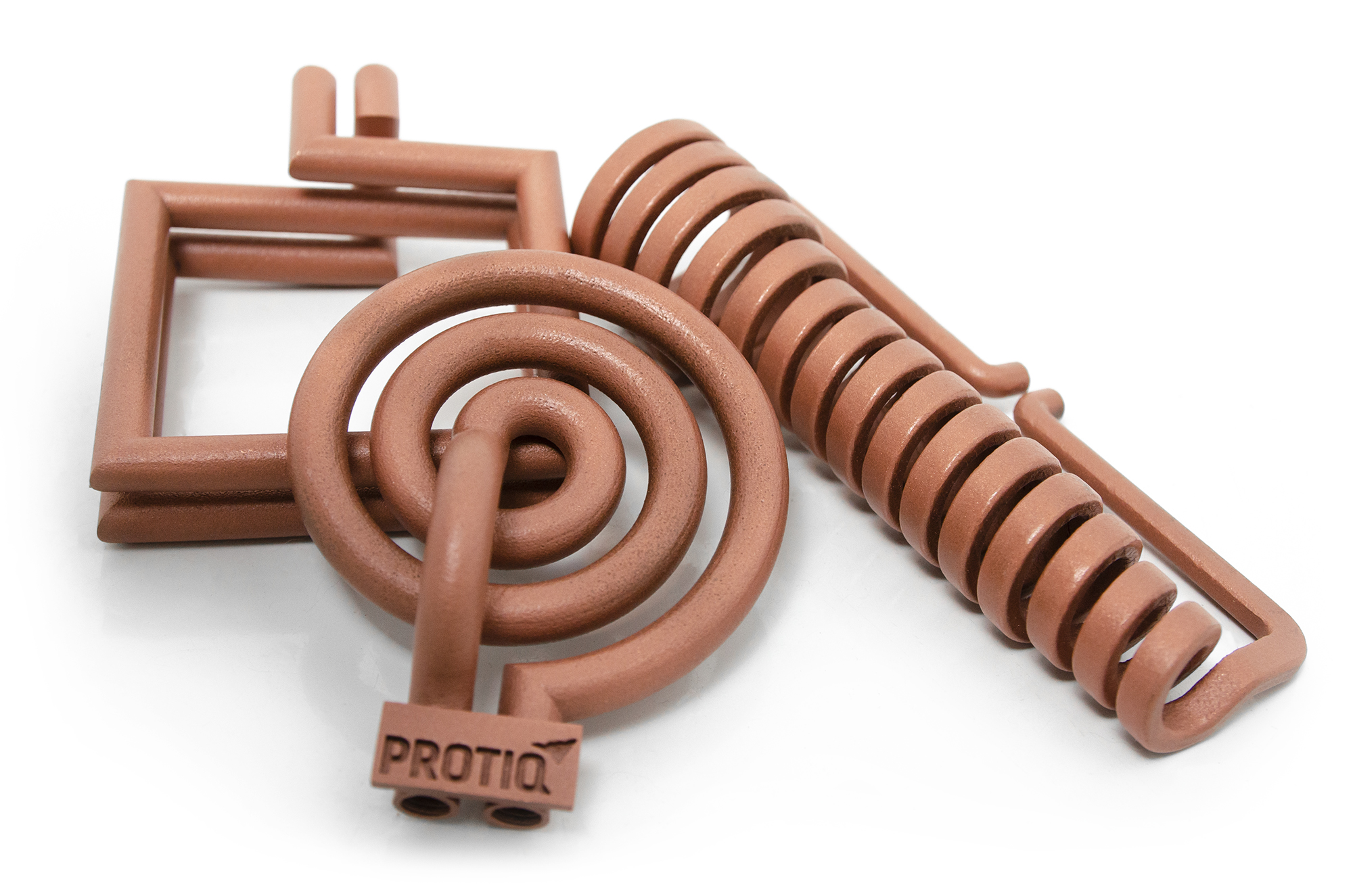
Inductors
Hollow copper coils with integrated cooling channels, precisely adapted to the workpiece – also configurable online.
More about inductors
Heat exchangers and heat sinks
Curved cooling fins, lattice structures and integrated channels increase the surface area and improve heat transfer.
More about heat exchangers
Data centers and electronics cooling
Cold plates and cooling components with freeform cooling channels – from chip cooling to liquid cooling in the data center.
More about data centers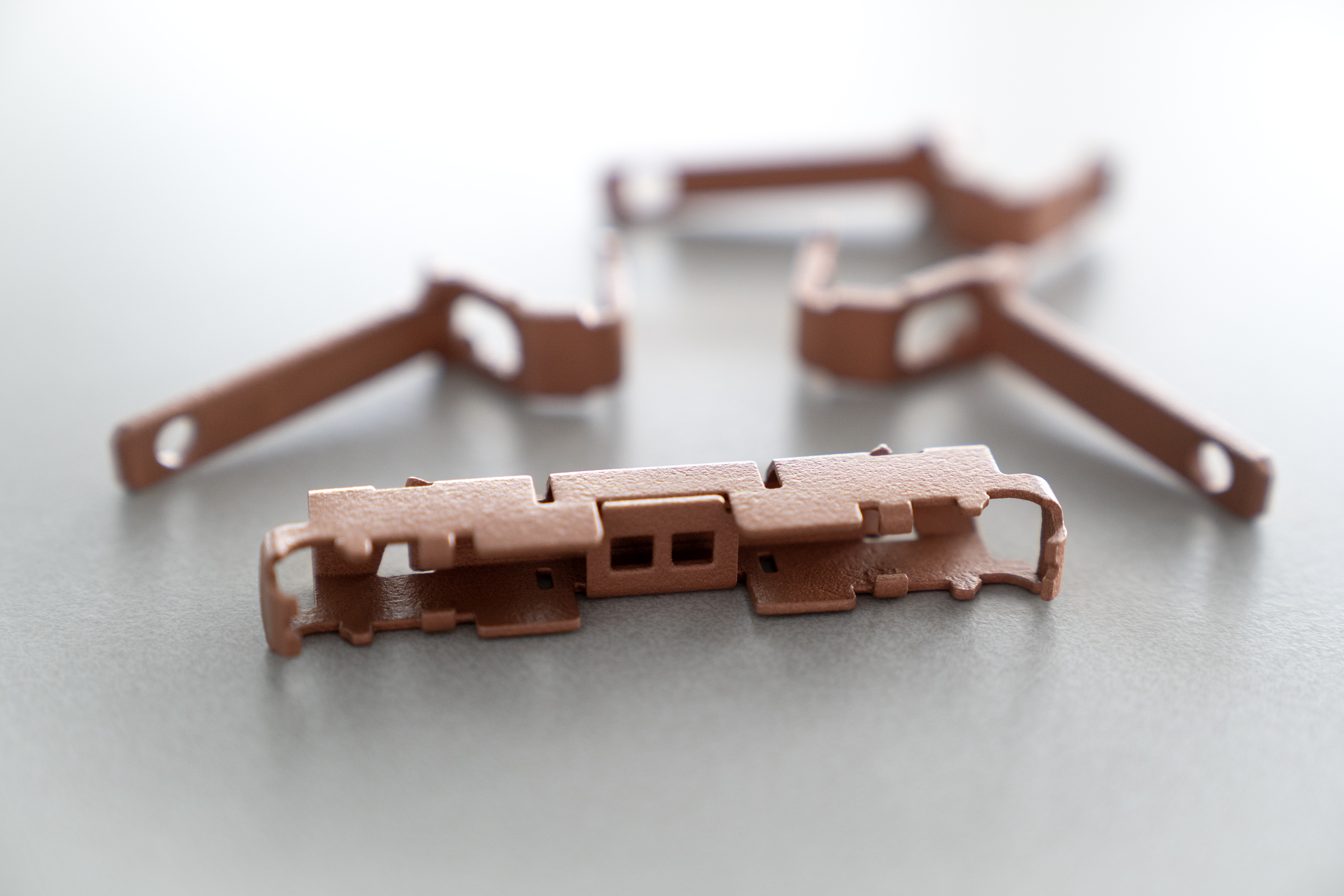
Busbars
Current-carrying parts and conductor structures in geometries that can only be produced to a limited extent conventionally.
More about busbarsFunctional prototypes for electronics and electric motors
For electrical tests and thermal analyses to be meaningful, prototypes should have the same material properties as the later series parts wherever possible. With copper from 3D printing, contact parts, connecting elements or conductor structures are produced quickly and without tooling. In electric motor development, conductor structures such as hairpin windings can also be tested as prototypes and specifically adapted.
Low-temperature applications
In cryogenic and other low-temperature applications, even small impurities can significantly affect electrical and thermal conductivity. This is where the high purity of pure copper low-O₂ is particularly interesting.
↑ Back to overviewExpertise
What makes PROTIQ an expert in copper 3D printing?
PROTIQ has been 3D printing copper since 2013, continuously develops its own copper materials and processes and supports copper projects from design to finished part – for inductors right through to simulation-based optimization.
More than a decade of experience
Since starting with RS copper in 2013, PROTIQ has continuously developed powder qualities, scan strategies and process parameters for copper.
Own materials and processes
PROTIQ produces pure copper, pure copper low-O₂ and RS copper in-house – with process strategies tailored to the respective application.
Engineering for inductors
From the inductor configurator and the design of special shapes to the simulation-based optimization of inductor geometries.
Proven in practice
In a project with IDEA GmbH, optimized 3D-printed induction coils lasted 4 to 6 times longer.
Order copper parts online or request a project
Upload your 3D data, select the right copper material in the configurator or request it from us – and compare offers at a glance. For simple coil shapes, there is the inductor configurator. For complex parts, our experts will advise you personally.
- Prototypes, one-offs and small batches
- Complex internal structures and integrated cooling channels
- Design advice from the PROTIQ team
3D data available
Upload file
Upload your CAD data, select the copper material and compare the offers.
Upload file nowSimple coil shape
Configure an inductor
Six basic shapes for internal and external field inductors, adapted using a modular principle.
To the inductor configuratorComplex project
Discuss your project
Special shapes, specific requirements or pure copper low-O₂? We will advise you personally.
Start project requestFAQ
Frequently asked questions about copper in 3D printing
What is copper 3D printing?
In copper 3D printing, parts are built up layer by layer from copper powder – directly from CAD data and without tooling. This makes it possible to produce complex geometries such as integrated cooling channels or function-optimized conductor structures that are difficult or impossible to manufacture conventionally.
Which process is used to 3D print copper?
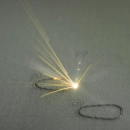
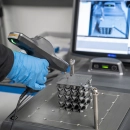
PROTIQ manufactures copper parts by selective laser melting (SLM). The machine applies metal powder layer by layer onto a build platform, and a laser selectively melts the powder where the part is created.
Why is copper difficult to process in 3D printing?
Copper reflects a large share of the laser energy and conducts heat away from the melt zone very quickly. The process window is therefore narrow: too little energy leads to incomplete fusion, too much to overheating, evaporation and porosity. Copper is also sensitive to oxygen and impurities.
Which copper materials are available on the PROTIQ Marketplace?
You can choose from pure copper, pure copper low-O₂, RS copper and the alloy CuCr1Zr. PROTIQ produces pure copper, pure copper low-O₂ and RS copper itself.
What conductivity does 3D-printed pure copper achieve?
Additively manufactured pure copper from PROTIQ achieves an electrical conductivity of up to 59 MS/m and a thermal conductivity of 415 ± 10 W/(m·K) at a density of 8.9 g/cm³.
What is the difference between pure copper and RS copper?
PROTIQ entered copper 3D printing with RS copper in 2013; the material has proven itself above all in inductors. Pure copper consists of 100% copper and achieves a significantly higher conductivity: up to 59 MS/m compared with 51 MS/m at the edge and 32 MS/m in the core for RS copper.
What is pure copper low-O₂?
Pure copper low-O₂ is a particularly low-oxygen variant of pure copper for parts that require particularly high purity. For this, PROTIQ has developed a coordinated material, process and post-treatment strategy that keeps oxygen pick-up as low as possible along the entire process chain – from the powder through storage and handling to the printing process.
What applications is 3D-printed copper suitable for?
Typical applications are inductors for induction heating, heat exchangers and heat sinks, cooling components for data centers and electronics, busbars and conductor structures, as well as functional prototypes for electronics and electric motors.
Is 3D-printed copper suitable for series production?
Yes. In addition to prototypes and one-offs, 3D-printed copper parts are also produced in small batches – especially when complex geometries or integrated functions such as cooling channels are required. We will be happy to clarify with you whether 3D printing is cost-effective for your quantity.
How do I get a quote for a copper part?
Upload your 3D data in the configurator, select the copper material and compare the offers. For simple coil shapes, use the inductor configurator. For complex projects or questions about the material, send us an e-mail.
↑ Back to overview