

 Deutsch
 English
 Italiano
-
Manufacturing service
-
Manufacturing processes
-
Materials
-
Manufacturing processes
-
Other services
-
Knowledge area





















Automatic component identification in the field of additive manufacturing
Deep Learning Reduces Sorting Effort and Potential for Errors
Industrial companies are in constant competition with their market competitors. To remain competitive here, internal processes must be continuously improved. To this end, all segments of the process chain must be considered. With this in mind, Protiq GmbH has analyzed the optimization potential in the sub-process of assigning printed components to the respective orders and has found an innovative solution for reducing sorting effort through automatic component recognition using machine learning.
In the field of industrial production processes, additive manufacturing represents a relatively young and emerging manufacturing process. Compared to conventional production processes, 3D printing offers various advantages. For example, the production costs of a component are largely independent of the number of parts to be manufactured. Since no product-specific tools or molds are required for production, even individual pieces can be manufactured inexpensively. Furthermore, the low manufacturing constraints result in a high degree of design freedom. The combination of these two positive aspects makes 3D printing ideal for the production of custom-made products or prototypes. Both private and industrial users therefore have the opportunity to implement almost any creative idea.
Combined production of different components in one building chamber
In order to minimize the time from the idea of a component to its delivery to the user, the entire process must be improved. In this context, Protiq has already automated large parts of its process chain. The sequence starts with the design and leads from the actual manufacturing process through quality controls to the finished component, which is shipped to the customer. The optimization starts with the calculation of production costs based on the CAD model and includes further steps of digital pre-processing as well as mechanical post-processing of the components. However, to further reduce the time that elapses between the customer's idea and the delivery of the real part to him, the complete process chain must be studied and improved. In this context, Protiq has taken a closer look at the process chain section of the part allocation that takes place after the SLS process.

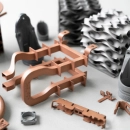
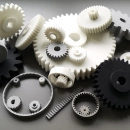
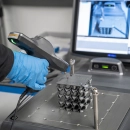
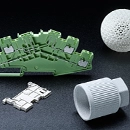
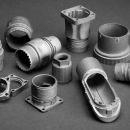
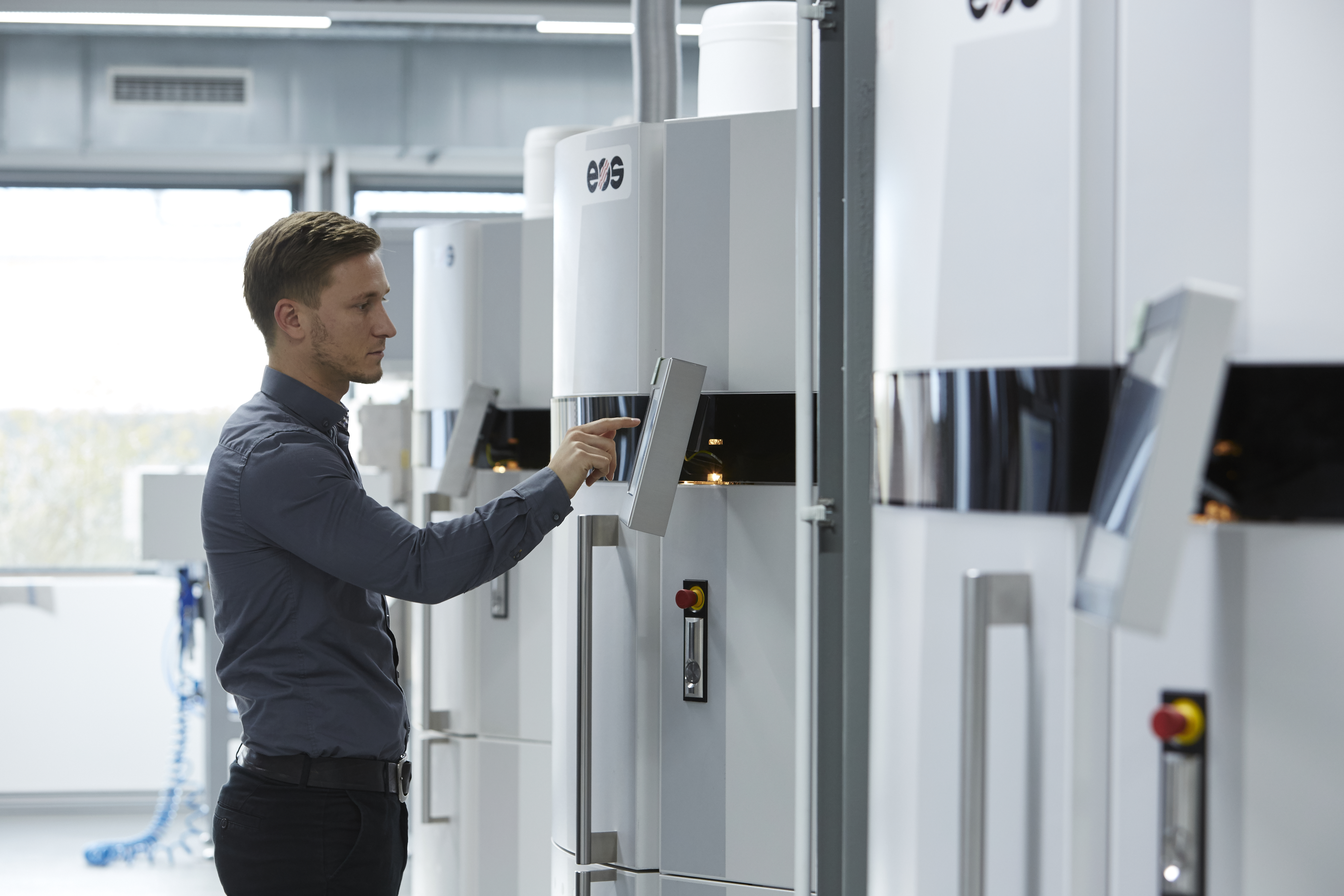
Selective laser sintering (SLS) is the most frequently used method for additive manufacturing of plastic components in industrial production. Here, plastic powder is applied layer by layer in a building chamber and melted by a laser where the component or components are to be created. Immediately after melting, the material hardens again to form a solid plastic body. By applying the powder in layers, a three-dimensional body is formed piece by piece. With SLS, the user has the capability of producing not just one component in an building chamber, but any number of different components that are nested three-dimensionally in space. In this way, the installation space is optimally used. However, this approach means that the jointly manufactured components have to be separated and sorted again after the manufacturing phase. This manual activity takes a great amount of time. To simplify the process, it is therefore possible to use automation technology methods.

Manual feature engineering for series components
In the age of Industry 4.0, the automation of production chains in many industrial processes has long proven to be state of the art. Robots with the associated sensors and actuators are used for this purpose. As an example of the use of so-called "machine vision" in serial production, consider the transport and sorting of goods on assembly lines. The use of modern camera technology enables the automatic identification of objects including their position and orientation on the conveyor belt. In this way, the objects can be automatically picked up and further processed by robots without human assistance.
In order for machine vision systems to automatically distinguish between different objects, they need information on how the individual objects can be recognized and what differentiates them from one another. The object properties are referred to as features. In the field of serial production, the objects to be picked are always the same serial parts.This fact offers the advantage that the features for differentiating the individual objects can be generated manually on the basis of the objects when setting up a new production line. Although manual feature engineering proves to be relatively time-consuming and can take days to weeks, it only needs to be performed once per production line. In addition, the machine vision system can be optimally adapted to the objects to be sorted.
Independent learning of deep features for automatic component identification
However, selective laser sintering is not usually used for series production. At service providers like Protiq, hundreds of different components are produced every day. With this in mind, the conventional approach to commissioning a sorting system is not practical. The daily manual feature engineering to split the currently produced components proves to be simply impossible. Therefore, in order to nevertheless perform automated sorting of the manufactured components, machine learning (ML) approaches must be used.
The use of machine learning methods is widespread in image processing. With the so-called Deep Learning (DL), a research area from the ML field is recommended for the described sorting system scenario. Its name derives from the use of deep learning systems, such as Deep Neural Networks (DNN). Corresponding systems are capable of autonomously learning numerous nonlinear problems using existing training data. The advantage is that manual feature engineering is no longer necessary. Instead, based on the training data, the system independently acquires so-called deep features. In the case of sorting, these are learned in such a way that the individual objects can be optimally differentiated by the features.

Parallel learning in the detection of components alongside real production
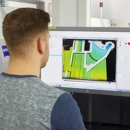
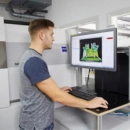
Protiq has used Deep Learning to design a system that can learn to differentiate components on a daily basis in parallel with real manufacturing. To do this, the manufactured components are captured by industrial camera technology on a scanning surface located at the sorting station. The trained system then decides which component it is based on the image of the item. Then, for each order, the associated components can be visually marked on the scanned surface. The process supports the sorting process and reduces the manual effort as well as the error potential in recognition process.
Today, machine learning and artificial intelligence (AI) can already be used in many industrial processes. In addition, research is constantly providing new insights that contribute to further system optimizations. As a result, application possibilities will steadily increase in the future, so that ML methods can make an increasingly large contribution to the automation and improvement of industrial processes.
More News


Are your 3D files ready?
Just upload your data. All files are automatically checked and optimized for printing.


