


 Deutsch
 English
 Italiano








Plastics for PolyJet and MultiJet: elastic materials in material jetting
Material jetting
Which plastics are available for PolyJet and MultiJet?
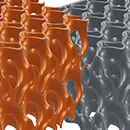
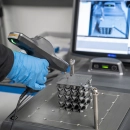
In material jetting – known by the names PolyJet and MultiJet – a print head deposits fine droplets of a liquid photopolymer that is cured immediately with UV light. Depending on the machine, this produces rigid, transparent, multicolor or elastic parts.
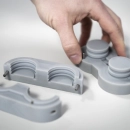
On the PROTIQ Marketplace, material jetting is available with two silicone-like printing materials of different hardness – for soft, elastic parts. The parts are produced by a manufacturer on the Marketplace.
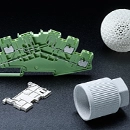
The materials are suitable for soft prototypes with fine details – for example samples of seals, grommets, buffers or grips.
Material jetting at a glance
- Process
- Material jetting (PolyJet / MultiJet)
- Materials
- silicone-like, elastic
- Hardness
- Shore A 35 or Shore A 65
- Production
- via a Marketplace manufacturer
- Support material
- water-soluble, removed
- Surface
- comparatively smooth
- Quantity
- single part to small batch
Further information such as the minimum wall thickness and property values can be found in the manufacturer’s datasheet for the respective offer.
Materials
Which materials can I choose from?
The two silicone-like printing materials differ mainly in hardness.
Soft: AR-G1L
Shore A 35 – for very soft, flexible parts such as seal samples, buffers or soft-touch elements.
Learn moreFirmer: AR-G1H
Shore A 65 – more dimensionally stable, for example for grommets, cable guides or grips.
Learn moreAlternative: TPU
For resilient elastic functional parts without support structures, TPU from laser sintering is a good option.
Learn moreAR-G1L & AR-G1H
Silicone-like printing materials: AR-G1L and AR-G1H
AR-G1L and AR-G1H are elastic photopolymers with silicone-like properties. They allow soft parts to be produced directly from the 3D data – without a mold.
- AR-G1L (Shore A 35): very soft and flexible – for seal samples, buffers or soft-touch elements.
- AR-G1H (Shore A 65): more dimensionally stable and with higher tensile strength – for grommets, cable guides or grips.
Both materials are printed with water-soluble support material. This protects thin-walled, elastic parts when the supports are removed. To find out exactly what Shore hardness tells you, read our article Shore hardness explained.
↑ Back to overviewSilicone-like or TPU?
Silicone-like printing material or TPU?
There are several ways to produce elastic parts. Material jetting stands out for fine details, TPU from the powder bed needs no support structures, and vacuum casting is a good option for several identical parts.
| Material jetting (silicone-like) | TPU in laser sintering | Vacuum casting | |
|---|---|---|---|
| Material | silicone-like photopolymer | thermoplastic polyurethane, e.g. TPU 80A | PU casting resins |
| Hardness | Shore A 35 or A 65 | Shore A 80 (TPU 80A) | depending on the casting resin |
| Surface | comparatively smooth, fine details | slightly rough and matte | depends on the master pattern |
| Supports / tooling | support material, removed | no support structures, no tooling | silicone mold made from a master pattern |
| Typical use | soft prototypes with fine details | elastic functional parts such as dampers or grips | small batches of identical parts |
Good to know
What should I consider with elastic printing materials?
Elastic parts place their own demands on the design. These points will help you with planning.
- Wall thicknessDo not design walls thinner than stated in the datasheet – with very soft material, it is better to allow some reserve.
- TolerancesIf tight dimensions are important, please clarify the requirements with us before ordering.
- TemperatureThe heat resistance values in the datasheet do not specify duration or load. Check whether the material is suitable for your application.
- SurfaceSurfaces in contact with the support material may turn out more matte than the other surfaces.
Ordering
How do I order elastic parts made by material jetting?
You order material jetting parts directly on the PROTIQ Marketplace – with a live price and free choice of manufacturer.
- Upload 3D fileUpload your 3D model. The system automatically checks whether the part fits into the build volume.
- Choose materialChoose AR-G1L or AR-G1H. The datasheet is linked to the offer.
- Compare offersCompare the price and production time of the offer.
- OrderOrder directly online or download a binding PDF quote.
FAQ
Frequently asked questions about plastics for PolyJet and MultiJet
Which materials are available for PolyJet and MultiJet on the PROTIQ Marketplace?
On the PROTIQ Marketplace, material jetting is offered with two elastic, silicone-like printing materials: AR-G1L with Shore A 35 and AR-G1H with Shore A 65. You can see which materials are available in the configurator after uploading your file.
Are the printing materials made of silicone?
No. AR-G1L and AR-G1H are photopolymers with silicone-like properties – soft, elastic and flexible. They are printed using material jetting and cured with UV light.
Which material is softer, AR-G1L or AR-G1H?
With Shore A 35, AR-G1L is considerably softer than AR-G1H with Shore A 65. AR-G1L is suitable for very flexible parts, AR-G1H for more dimensionally stable elastic parts.
When is TPU the better choice?
TPU from laser sintering needs no support structures and is suitable for resilient elastic functional parts such as dampers or grips. Material jetting, on the other hand, reproduces finer details and is a good option for soft prototypes with a smooth surface.
Where can I find the datasheets for the printing materials?
You can find the valid datasheets in the ordering process: after you upload your 3D file, the manufacturer’s datasheet is linked to the respective offer.