

 Deutsch
 English
 Italiano
-
Manufacturing service
-
Manufacturing processes
-
Materials
-
Manufacturing processes
-
Other services
-
Knowledge area










.jpg)
Increased Productivity through Automation along the Additive Manufacturing Process Chain
Additive manufacturing offers enormous potential for industrial applications due to a significant increase in design freedom compared to conventional manufacturing processes. In order to usefully implement the advantages of these new degrees of freedom, particularly from the perspective of cost-effectiveness, automation and linking of manual process steps in 3D printing are required. In this way, productivity can be increased significantly and additive manufacturing can be taken to a new, industrial level. Automation has also played a significant role at Protiq since the online platform went live in December 2016.

Automation was already demonstrated by the parent company before the spin-off
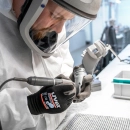
Even before it was spun off as a subsidiary of Phoenix Contact GmbH & Co. KG, the toolmaking unit formerly known as "Rapid Solutions" was able to experience first-hand the challenges of full automation in the field of conventional manufacturing. Phoenix Contact's internal toolmaking unit is among the top in its sector and one of the best in the German-speaking world. As a participant in the prestigious "Excellence in Production" competition, the toolmaking unit has already been named overall winner and "Tool Shop of the Year" twice. These awards could be achieved through a consistent implementation of Industry 4.0. This is particularly evident in a fully interlinked, automated production. This spirit in terms of technological progress as well as the continuous drive for innovation has also become part of the companys DNA from the very beginning. Accordingly, the automation of manual process steps was already taken into account when Protiq was founded. Here, both the digital side, in form of the continuously growing platform, and the analog side, in the form of intelligent interlinking in production, are equally essential factors. These two sides merge in the store and are omnipresent up to the delivery of the customer's order.

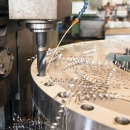
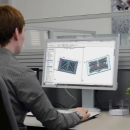
Fig. 1: (Production cell) Fully interlinked, automated production cell in the internal toolmaking unit of Phoenix Contact GmbH & Co. KG as an example of consistent implementation of Industry 4.0.
The digital platform offers the customer full flexibility
At the digital level, Protiq maps manual process steps such as quotation generation, the ordering process, production planning as well as material handling and the end-to-end traceability of orders in an automated process chain. This way, the great advantage of speed can be maintained and used in the additive manufacturing process. The customer can upload his individual CAD data set to the website at any time, analyze it and even have it automatically repaired. In addition to the visual feedback of his model, he receives immediate information about the basic manufacturability, the cost of all available materials and the estimated delivery time. Once the configuration process is completed, an order can be placed immediately or shared as a project. Once the customer has placed the order, it is imported into the enterprise resource planning system, the manufacturability is checked again in detail, and the order is included in the order management and production planning. At the same time, the delivery date is announced and the customer is continuously informed about the current production status. Using the production planning system (PPS), the customer order is digitally tracked from the time of the order through to the delivery and updated with additional information at every step of the process. As a result, a digital component file is created parallel to the production process, containing all the necessary information, such as the run card, measurement reports, build job layout and design. In that way, an identical production can be ensured long after the job has been completed. This factor is particularly important in the area of serial production, as reliable reproducibility must be ensured.
Along with the PPS, Protiq's analog production is also pursuing the goal of full automation and is already working partially automated in many areas. In 2019, for example, the entire powder handling in the area of laser sintering was successfully automated, from powder feed, to powder transport, to powder supply. Here, the entire powder handling is organized via a fixed pipe system. The specifically developed control system synchronizes new, old and building powder silos, unpacking stations, and sieving and mixing units with each other, analyses requirements, and ensures the automatic supply of processable building powder to the laser sintering machines. This way a continuous production and production line can be established for this process.

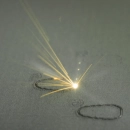
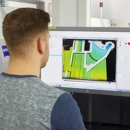
Fig. 2: (SLS) Automated powder handling continuously supplies the machines in the plastic laser sintering area with building powder.
Automatic component recognition as decision support in post processing
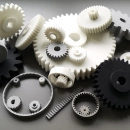
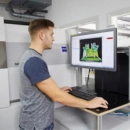
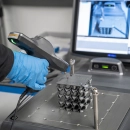
Protiq already relies on partial automation in the area of post-processing and quality management through the use of a decision-support system. This technology, which was developed in-house, enables automatic assignment from a large number of components to the correct order after the manufacturing process. This is particularly beneficial for plastic laser sintering, since this manufacturing process makes it possible to produce not just one component but any number of different components in a single building space. These are nested three-dimensionally in space and must be separated and sorted again after the manufacturing process. The automated component recognition is based on autonomously operating deep-learning algorithms - often referred to as artificial intelligence - and was developed specifically for this application. This supporting system can drastically reduce the time required for sorting, as the operator can spread out several components on a scan surface, start the software and then move on to another task. Once the recognition process is complete, the desired job can be selected. The corresponding parts are then color-coded using a projector and can be sorted. In addition to reducing manual effort, this also reduces the potential for errors.

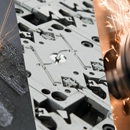
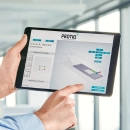
Fig. 4: (Component recognition) In automated component recognition, industrial camera technology is used for the visual detection of a wide variety of geometries. By interacting with a touch display, the correct components for each order can be color-coded and sorted via a beamer.
Transparency for the customer as an excitement factor
According to the guiding principles "Precise. Fast. Reliable.", Protiq's focus is on the customer and his components. In the age of digitalisation, it is particularly important to offer the highest possible transparency. In addition to the marketplace function on the Protiq platform, the customer can be involved in the manufacturing process as much as possible. The end-to-end automation at Protiq brings advantages for series production in particular: In the final state, the customer should know at any time exactly which process step in the production line his components are currently in.
More News

Are your 3D files ready?
Just upload your data. All files are automatically checked and optimized for printing.


